
On Friday afternoon, I opened The Street. By Sunday morning the novel was read and thoroughly marked up with chicken-scrawl notes. From the foreword alone, I became convinced that Mordecai Richler understood his post-war Jewish community in Montreal better than anyone. By the end, I was convinced I had lived it alongside him. Though the book may appear to be a simple weekend read, the Montreal it contains is immensely vibrant. Each story returns to the familiar Rue St. Urbain, where Richler grew up. Together, the vignettes form a portrait of a community whose youth are caught between Yiddish curses and English aspirations.
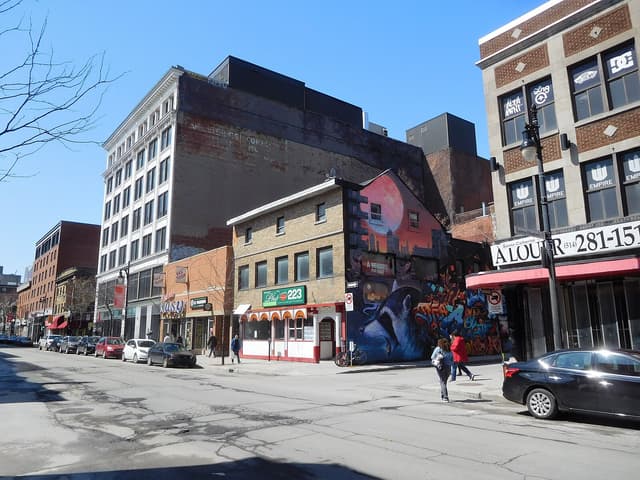
Richler, best known for The Apprenticeship of Duddy Kravitz and Solomon Gursky Was Here, is recognized as one of Canada’s most sardonic chroniclers of Jewish life. His writing bristles with impatience for hypocrisy and the conviction that humour is the only honest response to human striving. He structures his work to make the reader wince and laugh in the same breath. The Street, a short, autobiographical piece, casts Montreal itself as a protagonist. Its stories are full of references that anchor the setting in time: the tenements of the Plateau, the merchants of St. Laurent Boulevard, the YMCA, and corner stores offering unsolicited advice along with your bag of milk.
These details give the book its local charge, but they also trace a larger arc. Richler’s Montreal is a city in motion. Families climb from the cramped apartments of the Main to the duplexes of Outremont, and finally to the cushy lawns of Côte St. Luc. This movement mirrors the evolution of the Jewish community he grew up in: earlier generations, shaped by an immigrant ethos of self-preservation and cautious hope; later generations, no longer merchants or shopkeepers but professionals and business owners. The community becomes more secure, and with that, less cohesive. The poverty thins out, but so does the Yiddish.
What makes The Street so compelling is Richler’s refusal to idealize any part of this world. He has no patience for nostalgia, even when he feels it. He mocks the snobbery of the newly successful as readily as the sanctimony of the rabbis, with the weary affection of someone who has battled both from within. He understands that “progress” always demands something in return, and that irony is often the last refuge of people who take neither poverty nor piety too seriously.
Reading The Street today, I’m struck by how little permanence Montreal allows. Synagogues become condos; the delis turn into vegan bakeries; every few years, a new neighbourhood claims to be the “real” Montreal. Yet the same questions keep circulating, like gossip that refuses to die: Whom are we trying to impress, and what are we willing to forget to do it?
Richler’s Montreal is mostly memory now, but sometimes it feels as though it’s hiding in plain sight—in the smell of smoked meat drifting past trendy new cafés, in the fleeting Yiddish mutter at a tourist lingering too long in the line at Cheskie’s. Reading The Street as I live in Montreal, it’s hard not to feel part of the same ongoing experiment: figuring out how to remain Jewish, Canadian, and half-skeptical all at once. Richler made peace with that uncertainty by laughing at it. The rest of us are still trying to get the punchline right.
Powered by Froala Editor