

I have only ever been to New Jersey for one reason: to attend a Shabbaton. A Shabbaton is a weekend-long gathering, often at a retreat centre or hotel, during which a community of Jews comes together to celebrate Shabbat. In my specific case, I attended the Hadar National Shabbaton in East Brunswick, New Jersey from January 30th–February 1st.
The Shabbaton attracted over 650 attendants of all ages from across North America and Israel. It was facilitated wonderfully by Hadar’s team of passionate and committed faculty members. The food was delicious, the space was lovely and the people were kind, knowledgeable, and full of life. Never before have I found myself a part of a community of individuals who are more open to connection: with one another, with the world of ideas, and, most importantly, with Hashem. I returned to Montreal after the Shabbaton feeling both spiritually and intellectually fulfilled.
As a Halakhic Egalitarian community, Hadar values the equal status of men and women in all facets of Jewish communal life. This includes communal prayer, which women and men both lead and participate in without a mechitza. On Sunday morning, during Shacharit services, I was shocked upon entering the shul to see hundreds of women wearing tefillin, traditionally only worn by men in Orthodox Jewish communities. Furthermore, davening throughout the Shabbaton was frequently led by women, whose higher pitched voices added colourful new dimensions to many tefillot that are regularly sung in shul.
In addition to their rigorous beit midrash, Hadar is renowned for their Rising Song Institute. The initiative, directed by Joey Wisenberg and Rabbi Deborah Sacks Mintz, seeks to “cultivate Jewish spiritual life through song” by organizing and supporting Jewish song circles across North America. These gatherings often involve musical instruments and the singing of nigunim, a form of mystical lyricless song popularized by the Hasidic movement.
At the Shabbaton, attendants eagerly gathered after havdalah for a song circle led by Wisenberg and Rabbi Sacks Mintz. Many participants shared with me that they attended the Shabbaton primarily to take part in this rather untraditional, yet deeply spiritual practice of the Jewish song circle.
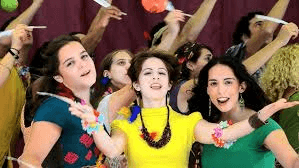
The song circle generated one of the most memorable moments of communal joy and connection over the course of the entire Shabbaton. Towards the end of the hour-long event, a group of young adults and teenagers began dancing together on one side of the room outside of the circle. Soon, older adults and younger children joined in, and the final minutes of singing came to a crescendo as approximately one hundred individuals of all ages spontaneously linked arms and danced joyously around the central circle.
Communal singing was a central component of countless other moments of connection over the course of the Shabbaton. During Kabbalat Shabbat on Friday evening, the Shaliach Tzibur strayed from the familiar Carlebach tunes, relying instead on Hadar’s original melodies. The singing was so beautiful that I was brought to tears during several moments throughout the service. After dinner on Friday night, Rav Aviva Richman and Rav Micha’el Rosenberg led a traditional tisch. At the tisch, I found myself seated with one hundred other Jews at a long table covered in colourful sweets and shining bottles of whisky, singing niginum for hours as we nourished ourselves with food, drink, and words of Torah.
Shiurim also began with the singing of nigunim, creating a warm and uplifting environment for Torah learning. Rabbi David Kasher led one such shiur, centred on the relationship between good and evil, entitled “How Do I Regard My Enemy: Ethical Lessons from the Maharal of Prague.” The discussion concluded with the powerful idea that both good and evil are necessary forces in the world; without the existence of evil, the choice to pursue and uphold goodness would be entirely meaningless.
At Hadar, goodness is upheld in so many ways. The davening is spirited, the community is kind, and the learning is nuanced and engaging. Indeed, the Shabbaton was a shining example of Hadar’s mission to create vibrant, practicing, egalitarian Jewish communities of Torah, Avodah, and Hesed.
Powered by Froala Editor