

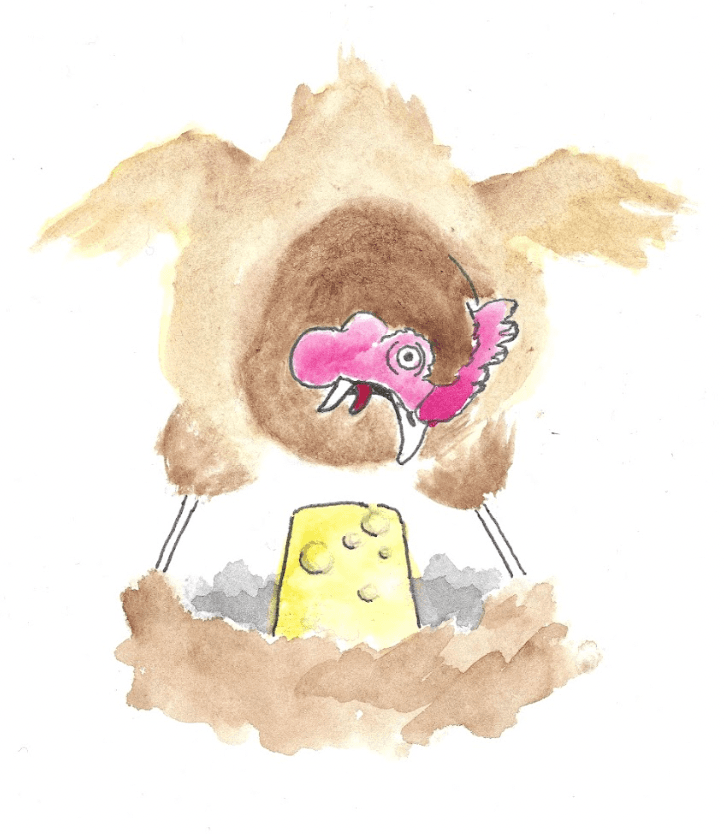

Last week, we read Parshat Mishpatim, the dreaded parsha of chicken-parm craving Jews across the globe, which states that “you shall not boil a kid in its mother’s milk” (Exodus 23:19). This line is repeated twice more throughout the Torah, in Exodus 34:26 and Deuteronomy 14:21. Sure, I understand the cruelty of eating an animal alongside the very thing meant to sustain its life. The prohibition against combining milk and meat emphasizes Judaism’s dedication to an ethical life. However, there are key facts missing. Namely, chickens do not produce milk. So why should I not be able to enjoy a crispy chicken parm sandwich from my favorite kosher schnitzel spot?
The common understanding of this rule is that Rabbis determined the combination to be trief (not kosher) out of fear that chicken and meat would be confused, leading to unkosher practices. In practice, this is extremely unlikely. First of all, have you seen a raw piece of chicken and a raw piece of beef? They look completely different. Unless chickens have undergone some crazy evolutionary process in the past 5,000 years, this excuse is ridiculous.But, if it isn’t a switched-at-birth kind of situation, then what is the history of this law?
As I mentioned earlier, the Torah really hammered in that we are not supposed to “boil a kid in its mother’s milk” via repetition. In the Talmud, in Chullin 8:4, the Rabbis explain that this repetition of “kid” three times represents that “an undomesticated animal, a bird, and a non-kosher animal” are excluded from being permitted to be cooked in milk. In Chullin 104a, the Gemara says that because “the Mishna does not distinguish between the meat of animals and that of birds, it may consequently be inferred that the meat of birds cooked in meat is prohibited by Torah law.” This law is derived by the Rabbis; it is not explicitly stated in any part of the Torah.
Chullin 113a explains the Rabbis’ decision to include fowl in the restriction, wherein it is determined that any type of meat must be thoroughly salted in order to fully get rid of the animal's blood (which Jews are also forbidden to eat). Since both chicken and animals produce copious amounts of blood when they are schechted (shocking, I know), they have to go through the washing and salting process as outlined in Siman 69 of the Sulchan Aroch (linked here, in case any DIY schechting and kashering is in your future!)
Maimonides explains that the Rabbis of the Talmud were afraid that Jews would come up with loopholes to the rule. For example, someone may say that just because eating fowl with milk isn’t explicitly prohibited, they can eat the flesh of a wild animal cooked in milk. Or that a goat could simply be cooked in the milk of a sheep. Or that only goats aren’t allowed to be cooked in milk, but any other milk-producing animal can be combined with dairy, no problem. Or, worst of all, maybe we are only not allowed to cook an animal in the milk that specifically comes from their mother, but if the milk comes from a different, unrelated animal then it is fine (Mishneh Torah, Rebels 2:5). The Rabbis wanted to ensure that the spirit of the law remained, despite a lack of direct instruction regarding all milk-producing animals. So, they declared that any food that needed to undergo the shechting and kashering process, fowl included, could not be combined with milk.
My question remains, though. Why can I not eat chicken and milk if I understand the moral issues behind the original prohibition? Although a large part of Judaism relies on following laws, a significant part of the religion is based on understanding the laws and the lessons they teach us about how we are supposed to interact with the world. Did the Jews in Rabbinic times follow the Torah if they didn’t understand the moral issues that arose with cooking an animal for meat? Does following Jewish Law require a complete understanding of what the law teaches,why it teaches that, and the benefits of adhering? Most people would say yes. In which case, I say this: if you know that the cow in milk is wrong, turn to chicken and cheese lifelong!
Powered by Froala Editor