
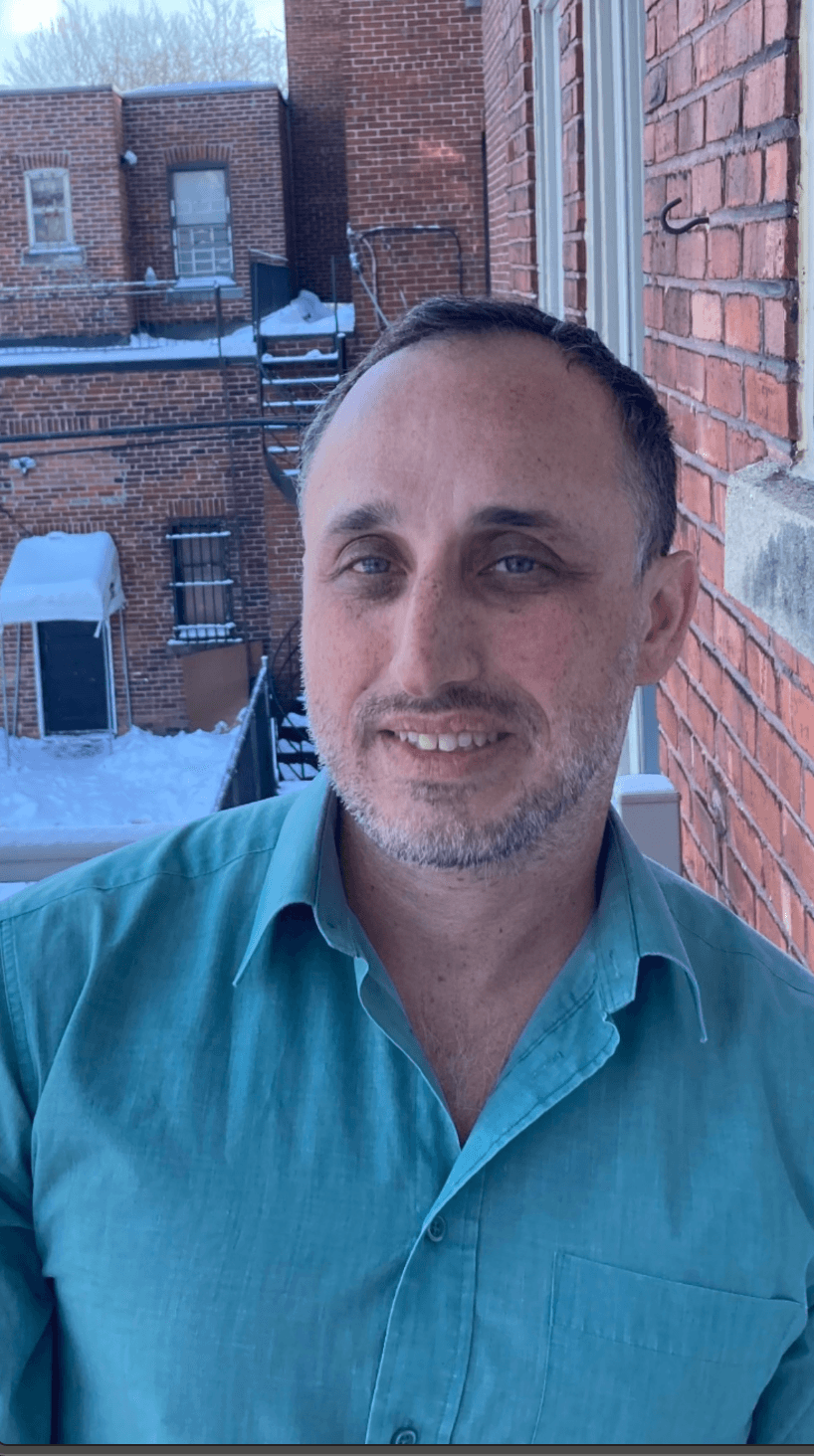

McGill’s newest professor of Yiddish literature, Adi Mahalel, did not always imagine himself surrounded by novels, archives, and students discussing diasporic modernity. He began his academic career studying engineering at the Technion, a science and engineering university in Haifa, Israel. Somewhere between problem sets and lab reports, he realized that what truly compelled him was language, story, and the intimacy of literature. “I found that the humanities offered something I couldn’t get anywhere else,” says Mahalel.
That realization carried him into the academic world of modern Hebrew and Yiddish literature. He now identifies as a scholar of both traditions, with a particular focus on Yiddish. At McGill this past fall, Mahalel taught “God and the Devil in Yiddish Literature,” and now teaches “Introduction to Yiddish Literature" in addition to Yiddish language courses.
Part of Mahalel’s attraction to Yiddish was personal. Growing up in Haifa, Mahalel heard Yiddish expressions at home, though no one in his family spoke the language fluently. As a child, he encountered Yiddish literature in Hebrew translation, reading works by Sholem Aleichem and Isaac Bashevis Singer. Over time, his curiosity about these works grew into a broader fascination with the intellectual and multifaceted world of Yiddish culture.
His first book, Radical Isaac: I. L. Peretz and the Rise of Jewish Socialism, focuses on literature’s interaction with the political ideologies of Peretz’s era. Hebrew and Yiddish, Mahalel emphasizes, have often been assigned ideological meanings after the fact. Hebrew became associated with Zionism and Jewish sovereignty; Yiddish became associated with diasporic culture and socialist or Orthodox movements. Historically, though, things were never so reductive.
“First of all, it’s a language,” he says. “People spoke it. Ideology comes later.” While Yiddish was central to Jewish socialist organizations and Hasidic communities, Hebrew also had a similar diasporic quality. The Haskalah, or Jewish Enlightenment, encouraged the use of Hebrew as a secular literary language.
Linguistically, the two languages have shaped each other. Modern Hebrew’s vocabulary draws from ancient sources, but its syntax reflects Yiddish. For Mahalel, this entanglement makes rigid oppositions between the languages misleading.
When asked about themes in Yiddish literature, he often returns to humor. Writers like Sholem Aleichem stylized spoken language to produce comedic works that convey emotional depth. Humor, Mahalel argues, emerges from minority experience. It is both a way to process vulnerability and to criticize power indirectly. Self-mockery, for example, a pattern that many argue is so central to Jewish comedy, expresses awareness and complexity rather than simple pessimism.
At the core of Mahalel’s scholarship lies a larger question: how have Jews processed modernity? As societies shifted from inherited forms of authority and community toward individualism, secularity, and the nation-state, how were Jews to understand themselves? Literature offered a space to experiment with new identities, often outside traditional religious frameworks. Language itself became a vehicle for creativity and collective experience. He is interested not only in what writers produced, but in the choices they made and the lives they imagined.
Many see Yiddish as a dying language, as most Jews outside Haredi communities no longer use it. However, beyond the Haredi world, people still engage with it through translation, poetry, theater, and an array of other creative mediums. Especially in Montreal, secular Yiddish culture remains alive. Mahalel noted Yung Yiddish, an organization that preserves Yiddish culture through art and advocacy, as an institution that keeps Montreal a “center for optimism” for Yiddish culture.
For students encountering Yiddish for the first time, Mahalel hopes the language feels less like a relic and more like an invitation into a culture that is still alive and still asking what it means to be Jewish in the modern world. “Great literature doesn’t expire,” Mahalel says. “People still read nineteenth-century writers. We read what lasts.”
His latest book, Boom and Chains: a Yiddish Novel set in Israel/Palestine, dives into the underexplored history of Yiddish in Israel/Palestine, bringing to life the complex historical dynamics his work centers on.
Powered by Froala Editor